
BLOG
Blog
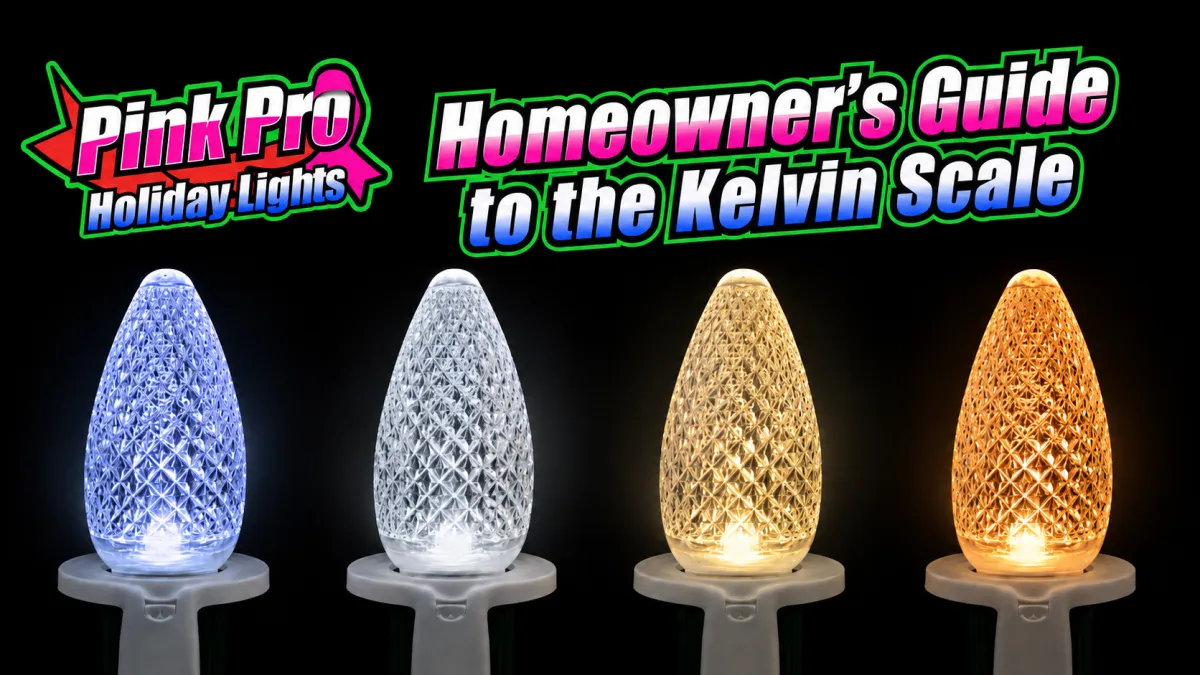
Warm White vs. Pure White vs. Cool White Christmas Lights: Homeowner's Guide to the Kelvin Scale
When it comes to Christmas lighting, selecting the right shade of white can make all the difference in the look and feel of your display. White LEDs come in several distinct tones, each offering its own ambiance — from nostalgic and cozy to crisp and modern. Understanding the differences between warm white, pure white, and cool white helps you create exactly the effect you want for your home or business.
It's the single most common question the team at Pink Pro Holiday Lights gets during a consultation, and it's usually the one Metro Detroit homeowners spend the longest deciding on. Pick the wrong white and a beautiful Birmingham roofline can feel cold and clinical, or a modern Oakland County home can end up looking dated. Pick the right one and the whole house comes together.
The Kelvin Scale: What Those Numbers Actually Mean
Every white light bulb has a color temperature measured in Kelvin (K). The scale runs roughly from 1000K to 10,000K, and it describes the tone of the white — not how bright it is.
Here's the part that trips people up: the scale runs backwards from what most people expect. Lower Kelvin numbers produce warmer, more golden light. Higher Kelvin numbers produce cooler, more blue-tinted light. A candle flame sits down around 1800K. Noon daylight sits up around 5500K–6500K. An overcast Michigan winter sky can read even higher.
The reference points most manufacturers anchor to look like this:
Warm White — around 2400K (golden, incandescent-like)
Pure White — around 4600K (neutral, no color cast)
Cool White — around 6000K (crisp, slightly blue)
When Pink Pro Holiday Lights specs a display, the team is working within those ranges, matching the tone to the architecture, the landscaping, and how the house actually reads from the street on a dark December night.

Warm White: The Classic Christmas Glow
Warm white is the most popular choice for Christmas lighting, and for good reason. Its soft, golden glow closely mimics traditional incandescent bulbs, creating a classic, inviting look. This familiar tone is ideal for a cozy, nostalgic holiday atmosphere.
Color description: Soft yellowish-white, similar to candlelight or incandescent bulbs
Note: Color temperature does not indicate brightness — warm white LEDs are just as bright as any other LED bulb
Best for: Traditional decor, indoor trees, warm-toned homes, cozy ambiance
Standard Kelvin range: 2500K – 3200K
Warm white is the workhorse of residential lighting across Birmingham, Royal Oak, and Grosse Pointe. It flatters red brick, warm-toned stone, tan and cream siding, and the wood-and-brick colonials you'll find all through Metro Detroit's most established neighborhoods. It photographs beautifully. It reads as "Christmas" to almost everyone who sees it.
If a Metro Detroit homeowner tells the crew at Pink Pro Holiday Lights they want the house to feel like the Christmas they remember growing up, warm white is nearly always the answer.
Pure White: Clean, Neutral, and Modern
Pure white LEDs emit a clean, neutral white light without any warm (yellow) or cool (blue) undertones. This color strikes a balance between modern and classic, and it's often used in displays where a crisp, elegant look is the goal.
Color description: Bright, neutral white with minimal color tint
Note: Color temperature is not the same as brightness — pure white can appear brighter visually, but actual brightness depends on the product specs
Best for: Modern displays, white-themed decor
Standard Kelvin range: 4000K – 5500K
Pure white is the tone that has grown fastest in popularity over the last several seasons. It's clean without being cold. On a white farmhouse with black window trim, on new construction with gray siding, or on a commercial storefront that needs to look sharp rather than sentimental, pure white is usually the right call.
It also plays extremely well with greenery. A pure white wrapped tree or a pure white garland run reads as elegant and intentional. The designers at Pink Pro Holiday Lights lean pure white for a lot of the commercial work done throughout Oakland County, where the goal is a polished, upscale look that stands out on a busy Metro Detroit street.
Cool White: The Icy, Contemporary Look
Cool white lights have a bluish tint that gives them a sharp, icy appearance. While often mistaken for pure white, the subtle blue tone makes them noticeably cooler. These lights are ideal for creating a wintry or contemporary look.
Color description: Bright white with a slight blue hue
Note: While cool white may appear harsher, this relates to color tone — not brightness level
Best for: Outdoor displays, snow or ice themes, modern decor
Standard Kelvin range: 6000K – 7000K
Cool white is the specialty tool of the three. Used well, it's stunning — icicle effects, snowflake motifs, wrapped bare branches, roof edges that look genuinely frozen. Used carelessly, it can make a warm traditional home feel like a parking lot.
The place cool white truly earns its keep in Michigan is on trees and hardscape. Even in a snowy Metro Detroit winter, cool white lighting on bare limbs and evergreens delivers a wintry feeling that amplifies the season. It's one of the effects Pink Pro Holiday Lights uses most often when a homeowner wants the "snow globe" look dialed up.
Why the Same "Warm White" Can Look Different
Here's something that catches Metro Detroit homeowners off guard every year: two boxes labeled "warm white" from two different manufacturers can look noticeably different side by side. LED color binning varies between brands, product lines, and sometimes even production runs. One company's warm white might sit at 2400K, another's at 3000K. That 600K gap is very visible when the strands are hanging next to each other on your Birmingham roofline.
This is one of the biggest advantages of hiring a professional. When Pink Pro Holiday Lights installs a display, every bulb comes from the same commercial-grade product line, so the entire roofline is a single consistent tone. No hot spots, no sections that read slightly yellower than the rest, no visible seam where one box ended and another began.

How Your Home's Materials Change Everything
The color of the light is only half the equation. The surface it lands on is the other half. A 2700K warm white looks completely different on white vinyl siding than it does on dark brick, because the surface absorbs and reflects different parts of the spectrum.
Red or orange brick: Warm white flatters it; cool white fights it
White or light gray siding: Pure white or cool white keeps it crisp; warm white can look yellowed
Tan or beige stucco: Warm white is the safe choice; pure white is a clean alternative
Dark or charcoal siding: Pure white and cool white pop dramatically against dark surfaces
Natural wood and stone: Warm white almost always wins
Part of what the designers do on every consultation at Pink Pro Holiday Lights is consider how the house reads after dark, because a facade in daylight and the same facade under holiday lighting can behave very differently.
Which White Photographs Best?
Warm white generally photographs the most flatteringly for family photos and holiday cards, because it produces the same golden glow that makes indoor portrait lighting appealing. Pure white photographs the most accurately — colors in the frame stay true, which matters for commercial and real estate photography. Cool white can be difficult in photos because cameras often overcorrect the blue, either washing it out entirely or exaggerating it. If holiday card photos on the front steps are part of the plan, mention it during your consultation with Pink Pro Holiday Lights and the design team will build the display with that in mind.
One more tone worth knowing about: "vintage" or "antique" white sits even lower on the Kelvin scale, typically 1800K–2200K. It's noticeably more amber than standard warm white and imitates old filament bulbs. It looks striking on historic properties and Craftsman homes throughout older sections of Royal Oak and historic Birmingham, but because it reads as distinctly orange next to standard warm white, Pink Pro Holiday Lights treats it as a whole-display choice rather than something to mix in.
Are LED Christmas Lights Actually More Energy Efficient?
Substantially. Professional-grade LED bulbs draw a fraction of the wattage of traditional incandescent equivalents, which means dramatically lower energy costs across the season and far fewer circuit limitations on large displays. They also run cool to the touch and hold up much better against the humidity, temperature swings, snow, and ice storms Metro Detroit sees every winter. Every installation Pink Pro Holiday Lights performs uses professional-grade LEDs for exactly those reasons — better looking, longer lasting, and cheaper to run.
Choosing Your White: A Simple Framework
If you're still on the fence, work through these three questions:
1. What feeling do you want? Cozy and traditional points to warm white. Elegant and modern points to pure white. Icy and dramatic points to cool white.
2. What color is your house? Warm materials want warm light. Cool and neutral materials can handle the full range.
3. What are you lighting? Rooflines and structures usually want warm or pure white. Trees, shrubs, and hardscape can carry cool white beautifully — even when the rest of the house doesn't.
And if the answer still isn't obvious, seeing it in person settles it fast. A side-by-side comparison of the three tones on your actual Metro Detroit home at night tells you more than any photo or chart ever will, which is exactly what Pink Pro Holiday Lights walks homeowners through during every free consultation.
More Than Lights: A Mission of Hope
Choosing Pink Pro Holiday Lights means supporting more than a service. A portion of every invoice supports Five Points of Hope, a Michigan-based nonprofit dedicated to assisting individuals experiencing financial difficulties while dealing with a cancer diagnosis.
This charitable commitment is deeply personal to Pink Pro Holiday Lights co-owner Jeremy Main, whose mother passed away from cancer when he was just 20 years old. She was only 40. The Pink Pro family wanted to honor her memory and make a real difference for Michigan families facing the same devastating diagnosis. Every warm white bulb on a Grosse Pointe roofline and every pure white strand on a Birmingham storefront contributes to that mission.
Let's Get the Color Right on Your Home
Warm white, pure white, or cool white — there's no single correct answer, only the right answer for your home. The Kelvin scale gives you the vocabulary, but the real decision comes down to your architecture, your materials, and the feeling you want when you pull into the driveway on a December evening.
That's the part Pink Pro Holiday Lights handles for homeowners and businesses across Birmingham, Royal Oak, Grosse Pointe, Oakland County, and the broader Metro Detroit area every single season. From the first consultation through design, professional-grade LED installation, in-season maintenance, takedown, and storage, the Pink Pro Holiday Lights team manages all of it so you never have to touch a ladder or second-guess a color choice.
Call Pink Pro Holiday Lights today at (248) 202-7636 for your free quote.

Does a lower Kelvin number mean the lights are dimmer?
No — and this is the most persistent myth in holiday lighting. Kelvin measures color, not output. Brightness is measured in lumens, and it's a completely separate spec. A 2400K warm white LED and a 6000K cool white LED from the same product line will typically put out the same lumens. The cool white may appear brighter to your eye because human vision is more sensitive to light in the blue-green part of the spectrum, but the actual light output is identical. If you want a brighter display, Pink Pro Holiday Lights adjusts the bulb size, the spacing, or the lumen rating — not the color temperature.
What Kelvin temperature is best for Christmas lights?
For most Metro Detroit homes, somewhere in the 2500K–2700K range hits the sweet spot. It's warm enough to feel traditional and inviting without pushing into the amber-orange territory that some very low-Kelvin "vintage" products land in. If your home has a lot of cool-toned gray or white siding, or you're going for a contemporary look, moving up to 4000K–5000K pure white often serves the architecture better. There's no universally correct number — it depends on your house, your landscaping, and the mood you're after, which is exactly why Pink Pro Holiday Lights walks through it during every consultation.
Which white looks best on a red brick home?
Warm white, almost every time. Red brick has strong warm undertones, and a warm white light source complements them — the brick glows and the whole facade feels rich. This matters a lot in Metro Detroit, where red brick colonials and Tudors dominate neighborhoods like Birmingham and Grosse Pointe. Cool white on red brick tends to create a slightly muddy, purple-ish cast where the blue light hits the red masonry. If you love the crisp look but have brick, pure white in the 4000K range is a workable middle ground that stays clean without fighting the material.
Can I mix warm white and cool white on the same house?
You can, but it takes real intention to pull off. Mixing tones randomly across a roofline is the fastest way to make a professional install look like a mistake — the eye immediately reads the inconsistency as a burned-out or mismatched section. Where mixing does work is when the separation is deliberate and structural: warm white on the house and roofline, cool white on the trees and shrubs to suggest frost. Same color throughout each element, clear visual boundaries. When Pink Pro Holiday Lights designs a mixed-temperature display, the entire layout is mapped out in advance so every transition looks like a decision instead of an accident.
Do cool white lights really look like ice?
They do, but the effect depends heavily on what they're lighting. On bare deciduous branches, evergreens, and white or light-gray surfaces, cool white genuinely reads as frost — which is a beautiful complement to actual Michigan snow. On warm brick, tan stucco, or beige vinyl, the blue tone clashes with the surface color and the icy effect mostly disappears. If you want the ice look and your house is warm-toned, the winning strategy is cool white in the landscaping and warm or pure white on the structure.
Why do my new white lights look different from last year's?
Almost always because of binning and product-line changes. Retail LED strands get reformulated between seasons, and the "warm white" you bought two years ago may not match the "warm white" on the shelf today. Adding a few new strands to an existing display is where this shows up worst — the new section stands out immediately. If you're expanding a display, buy the additional strands from the same manufacturer and product line, or plan to replace the whole run so everything matches.
It's also worth knowing that cheap consumer strands can shift color over time — dimming unevenly or developing a greenish or pinkish cast within a few seasons, especially after repeated exposure to Michigan's humidity, snow, and temperature swings. The commercial-grade product Pink Pro Holiday Lights installs holds its tone season after season.
Do you offer free consultations to help choose a color temperature?
Yes. Every design consultation with Pink Pro Holiday Lights is free, and color temperature is one of the first things the team walks through. The designers look at your home's materials, its architecture, the landscaping, and how the property reads from the street, then recommend a tone that works with all of it. There's no charge and no obligation.
How early should I book to get the color I want?
Earlier than most people think. The best installation dates in Birmingham, Royal Oak, Grosse Pointe, and the broader Oakland County area fill up through the fall, and specific product lines can run short late in the season — which occasionally limits color options for last-minute bookings. Reaching out in September or October means you get your preferred tone, your preferred install date, and time to make changes before the season starts. Booking with Pink Pro Holiday Lights early is the simplest way to guarantee the display you actually want. Call (248) 202-7636 to lock in your date.






© Copyright 2026. Pink Pro Holiday Lights. All Rights Reserved.